
Series-Hybrid Light Aircraft
Would a battery + fuel-burning generator beat a gas engine in a light aircraft?
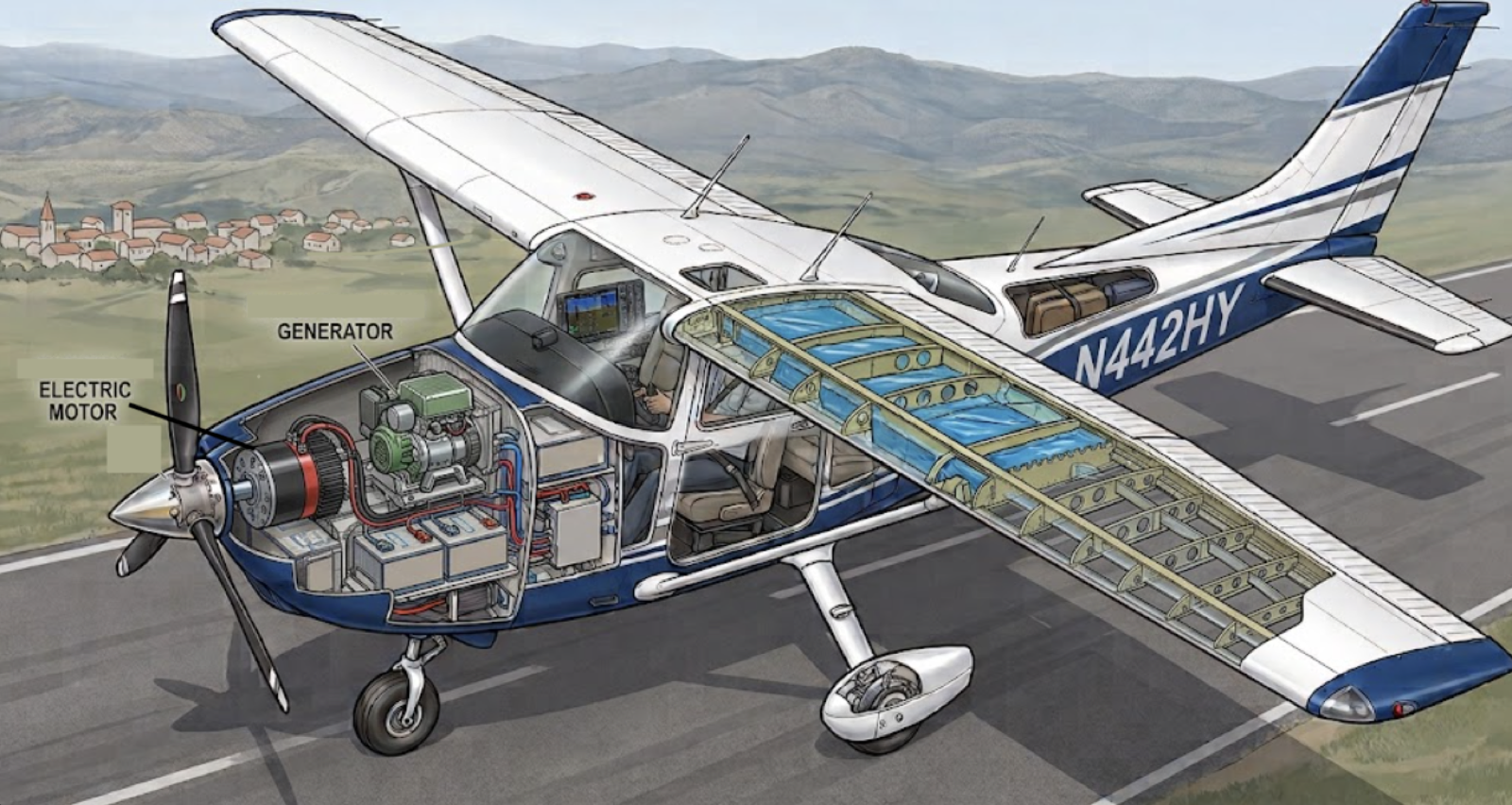
Overview
A feasibility study on swapping a light aircraft's piston engine for a series-hybrid drivetrain, a battery-boosted motor run by an onboard generator burning diesel. It works through the propulsion physics, weight, maintenance, and density-altitude performance, with a parametric range calculator across ten common Cessna and Piper singles.
By the numbers
Energy density is the whole problem
Range comes down to useful energy per kilogram, and that is where a battery loses badly. On the same mass, liquid fuel carries roughly 16 times the usable energy of a modern pack, so the battery buys minutes of boost, not miles of range.
Liquid fuel vs a modern lithium pack, from the feasibility math.
And it costs more to build
A hybrid conversion means buying two powertrains, an electric side plus a genset, instead of overhauling one engine. The parts land well above a standard overhaul before any certification headaches.
Hybrid parts (low and high estimate) vs a conventional piston overhaul.
Pros & Cons
Density altitude: electric power is independent of air density, so battery-boosted takeoff and climb hold full power where a normally-aspirated piston loses ~3% per 1,000 ft.
No range gain: on the same liquid fuel, ~14% electrical conversion losses cancel the genset's constant-RPM efficiency edge, leaving range roughly break-even or worse.
Engine wear: the genset runs at constant RPM and load, avoiding the full-power takeoff, idle-to-full cycling, descent shock-cooling, and propeller loads that wear a direct-drive engine.
Battery is a buffer, not a fuel tank: liquid fuel holds ~16× more useful energy per kg than a modern pack, so the battery adds weight and eats useful load while buying minutes, not miles.
Corrosion: the electric motor avoids the disuse-and-weather corrosion (cam/lifter rust, acidic oil) that kills infrequently-flown piston engines; the battery only calendar-ages.
Still a combustion engine: the genset keeps burning fuel and corrodes when parked, so battery and power-electronics upkeep are added on top rather than replacing engine maintenance.
Power on tap: electric motors are light and cheap to over-spec, so battery boost can deliver well over 125% of the original engine's power for takeoff while a smaller cruise-sized genset handles the steady state.
Cost and certification: parts run ~$50–80k (two powertrains vs. a ~$30k overhaul), and a certified drop-in is impractical - realistically Experimental R&D with no-passenger / no-hire limits.